







Casual Members Instructions to sign up in Eventor
To enable you to pre-enter for any Orienteering Events you will need to set up an account in Eventor (the software that controls all Orienteering Events and allows people to pre-pay for the Events). The information in Eventor is used to register details (e.g. SI stick details) and contact you or, in the case of an emegergency, an Emergency Contact can be contacted. These details allows tracing to be performed if there is a Covid19 issue.
How to Register and Add Yourself as a State Casual in Eventor
Here is the link to access Eventor - https://eventor.orienteering.asn.au/Events
Below are screenshots showing the steps in how a person can register themselves and then add themselves to their state casuals.
Step 1: Select ‘Create Account’

Step 2: Select ‘social network’ if you want to use it to login, otherwise select ‘Don’t associate…’

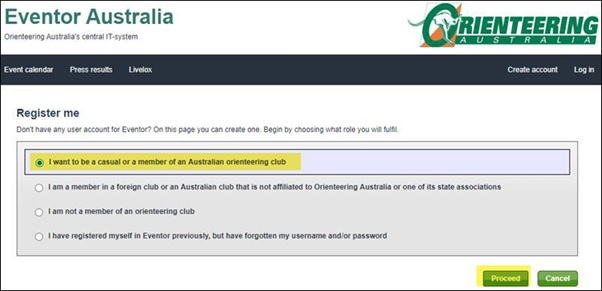
Step 3: Select ‘I want to be a casual or a member of an Australian orienteering club’ then ‘Proceed’
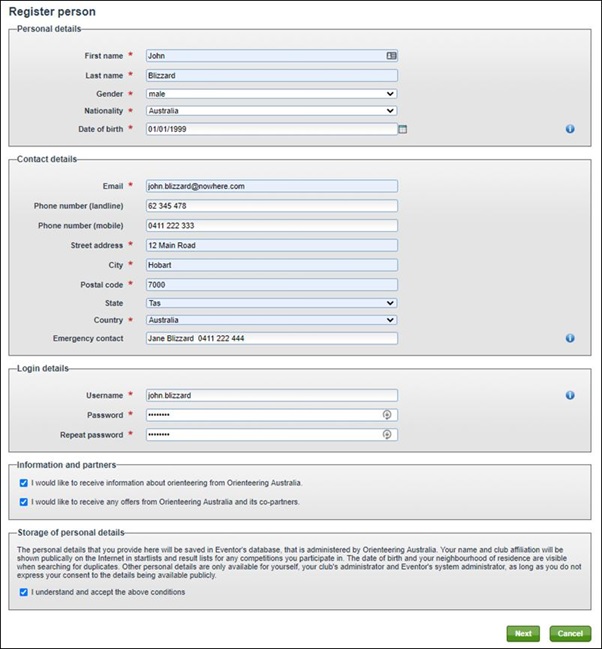
Step 4: Enter all details, tick ‘I understand and accept terms’, press ‘Next’
Step 5: Check details and press ‘Save’

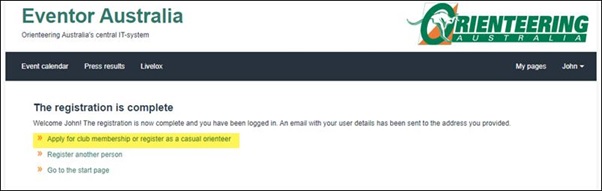
Step 6: Select ‘Apply for club membership or register as a casual orienteer’
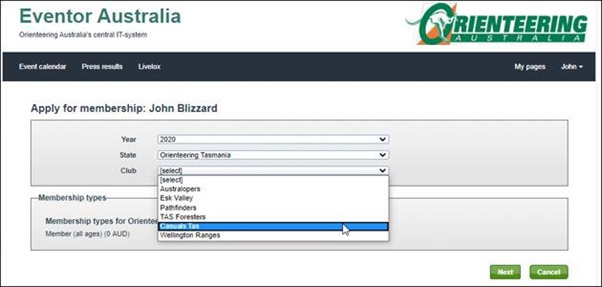
Step 7: Select Year, select State and from Club select ‘Casuals <your state>’. Press ‘Next’
Step 8: Job done! You are now registered as a casual in your state.
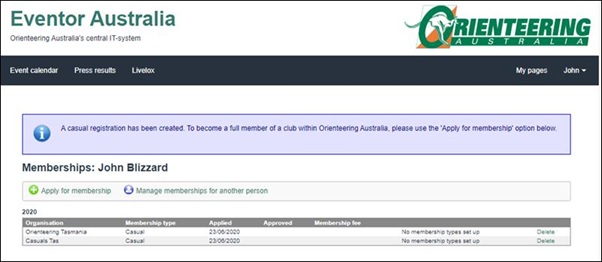
You can now log in and enter the Event using your login.
To Pay for an Event
Log in to Eventor and select the Event you would like to enter and continue to the Payment page.
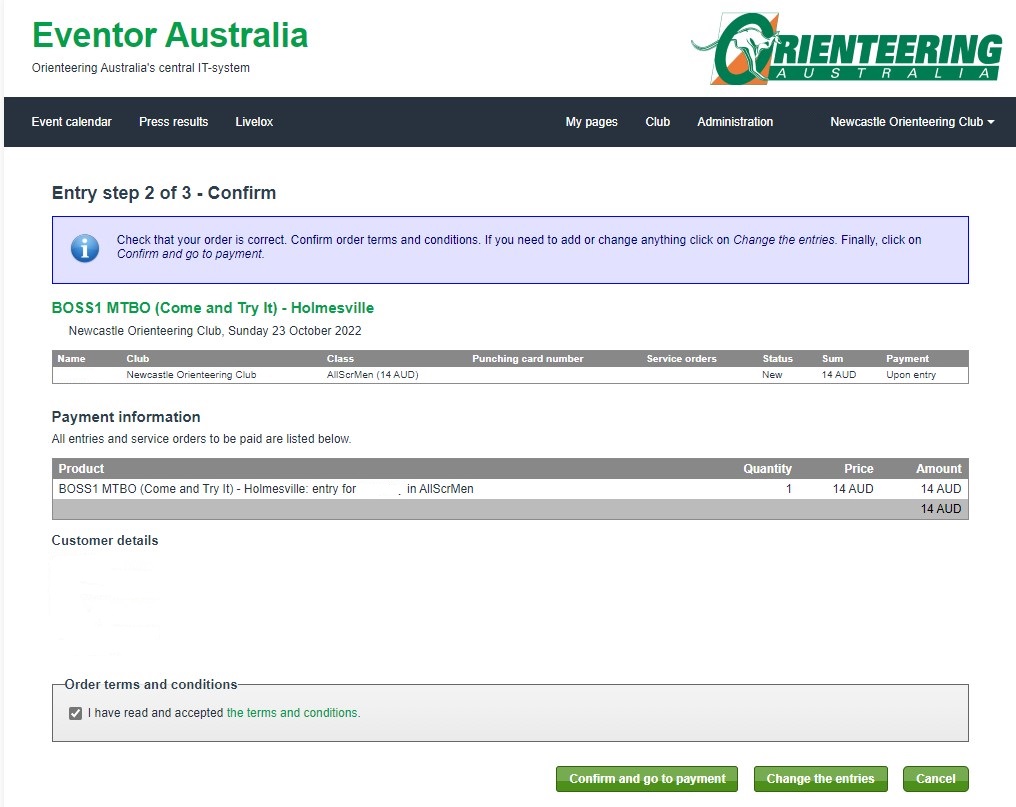
Select "Confirm and go to payment".
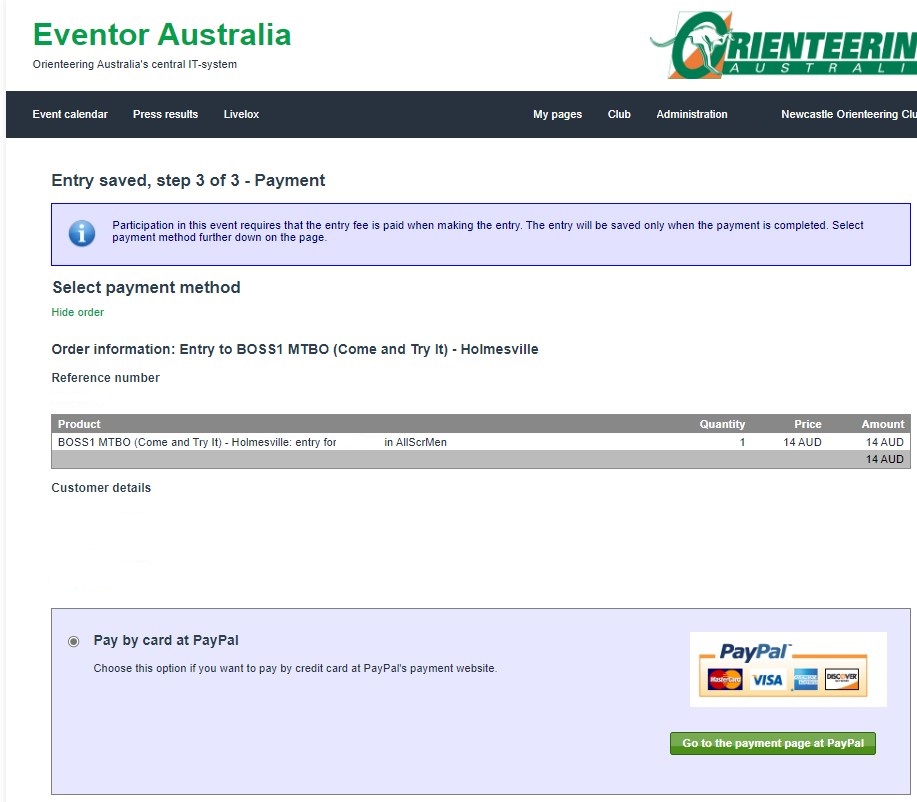
Click on "Go to payment page at PayPal". You will be able to pay using a credit or debit card even if you don't have a PayPal account.

Click "Pay with a Card".
Enter a none PayPal email address (e.g. This email address is being protected from spambots. You need JavaScript enabled to view it.) so you can use PayPal to pay using a card.

Click "Continue to Payment".

Click "Pay with Card".

Click "Contine to Payment".

Click "Continue as a Guest".
Enter your credit or debit card details.
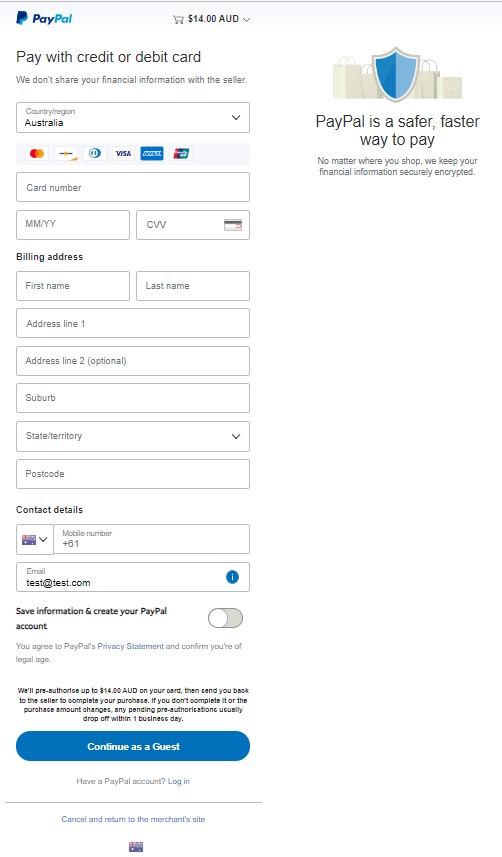
Click "Continue as a Guest".
Here is the link to access Eventor - https://eventor.orienteering.asn.au/Events
Try orienteering for free
-
Brickworks Park - Wallsend. Free. Print a copy of the map here.
-
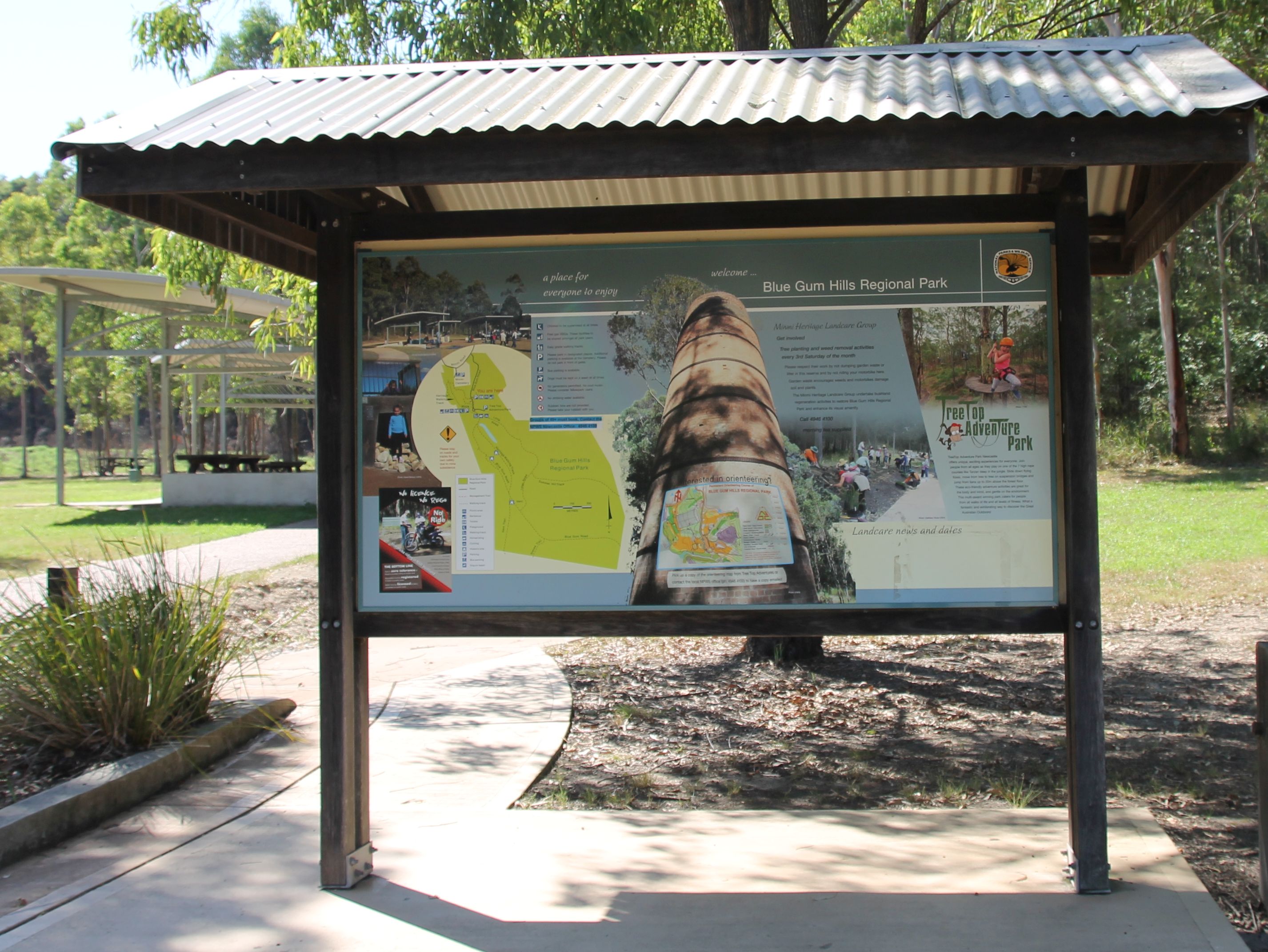
Blue Gum Hills Regional Park - Minmi (in conjunction with NPWS). Free. The course is available to use whenever the park is open. Print a copy of the map here.
-
Hunter Wetlands Centre - Shortland (*admission fees apply). The orienteering course is included as part of your Hunter Wetlands Centre admission fee. Print a copy of the map from their website here or grab one at the Wetlands Centre reception.
These permanent courses have checkpoint markers (orienteers call them "controls") set in place at various locations on the map. You decide in what order you visit the controls. You can visit them in numerical order, aim for the shortest route to visit them all, or set your own course.
Already had a go at one of the permanent courses? If you have any feedback or you have spotted an issue (eg. you find that there is a control marker missing) please let us know by emailing This email address is being protected from spambots. You need JavaScript enabled to view it..
Newcomers are also eligible for discounted entry fees at Newcastle Orienteering Club events if it is their first time at orienteering.
NPT #1 - 2007
Maps: Qualifiers - Jesmond Park, Speers Point Park, Walka Water Works
Final - Newcastle University
Winners: Long Course: A Grade - Wes Dose
First Female - ?
B Grade - ?
C Grade - ?
Short Course: D Grade - ?
Comment: Attendances - 59, 69, 61, ??. Number of qualifiers for the Final - 62
Inaugural series put on to try to entice street orienteers to try bush orienteering
NPT #2 - 2008
Maps: Qualifiers - Maitland Park, Blackbutt Reserve, Thomas Halton Park
Final - Walka Water Works
Winners: Long Course: A Grade - ?
First Female - ?
B Grade - ?
C Grade - ?
Short Course: D Grade - ?
E Grade -?
Comment: Attendances - 69, 81, 69, ??. Number of qualifiers for the Final - 72
NPT #3 - 2009
Maps: Qualifiers – Warabrook, Rathmines Park, Blue Gum Regional Park
Final - Lambton Park
Winners: Long Course: A Grade - Joshua Blatchford
First Female - Jenny Enderby
B Grade - Leigh Hoy
C Grade - Elly Ross
D Grade - Scott Taylor
E Grade - Brock Smith
Short Course: F Grade - Matt Hayes
First Sub Junior - Matt Hayes
Comment: Attendances - 96, 96, 91, 95. Number of qualifiers for the Final - 84
NPT #4 - 2010
Maps: Qualifiers - Speers Point Park, , Hunter River High, Braye Park
Final - Shortland Wetlands
Winners: Long Course: A Grade - Steven Todkill
First Female - Jenny Enderby
B Grade - Scott Taylor
C Grade - Greig Scott
D Grade - Duncan McLeod
E Grade - Margaret Peel
Short Course: F Grade - ?
G Grade - ?
Comment: Attendances - 102, 84, 69, ??. Number of qualifiers for the Final - 88
NPT #5 - 2011
Maps: Qualifiers - Maitland Park, King Park, King Edward Park
Final - Hunter River High
Winners: Long Course: A Grade - Joshua Blatchford
First Female - Malin Anderson
B Grade - Bjorn Mella
C Grade - Carolyn Matthews
D Grade - Russell Rigby
Short Course: E Grade - Luke Robertson
First Sub Junior - None unassisted
Comment: Attendances - 76, 71, 76, 83. Number of qualifiers for the Final - 76
SI timing used in the final.
NPT #6 - 2012
Maps: Qualifiers - Stephenson Park, Blackbutt Reserve, University East
Final - Blue Gum Regional Park
Winners: Long Course: A Grade - Alex Massey
First Female - Jenny Enderby
B Grade - Kim Van Netten
C Grade - Steven Roberts
D Grade - Luke Robertson
Short Course: E Grade – Graeme Taplin
First Sub Junior - Claire Burgess
Comment: Attendances - 93, 66, 69, 76. Number of qualifiers for the Final - 78
NPT #7 – 2013
Maps: Qualifiers - King Edward Park, Boomerang Park, Thomas Halton Park
Final - Booragul Primary School
Winners: Long Course: A Grade - Alex Massey
First Female - Jenny Enderby
B Grade - Angus Roberts
C Grade - Michael Goode
D Grade - Graham Fowler
Short Course: E Grade - Graeme Taplin
First Sub Junior – Alec Power
Comment: Attendances - 89, 75, 82, 65. Number of qualifiers for the Final - 71
First series to use SI timing in all events.
NPT #8 – 2014
Maps: Qualifiers - Lambton Park, Botanic Gardens, Shortland Wetlands
Final - Walka Water Works
Winners: Long Course: A Grade - Joshua Blatchford
First Female - Jenny Enderby
B Grade - Glenn Burgess
C Grade - Greig Scott
D Grade - Grant & Hamish Watson
Short Course: E Grade - Graeme Taplin
F Grade - Mikayla Enderby
First Sub Junior – Mikayla Enderby
Comment: Attendances - 79, 82, 80, 70. Number of qualifiers for the Final - 84
 Newcastle Park Tour 2007-2014 "Honour Roll"
Urban orienteering in Newcastle began as the "Newcastle Park Tour" in 2007 in response to a number of factors. Firstly, with daylight savings having been extended to six months of the year it seemed a pity to waste those extra daylight hours on a Wednesday evening. Secondly, the Summer Street Series had already been extended to seventeen events and it was felt that this was a plenty long enough season. Thirdly, and finally, numbers in the Street Series had grown to around hundred per week but many of these participants did not come along to the traditional bush orienteering events over winter. It was thought that a park series might be a gentle way of transitioning street orienteers to bush orienteers.
The format for the series has remained unchanged since its inception with three "qualifying" events followed by a graded final. The number of events was initially dictated by the number of weeks left of daylight saving after the street series concluded and by the small number of park maps that the club had available at the time. The decision to have only two courses (long and short) per event was made to try to make the demands on the course setter as small as practical (since the course setter has to put the controls out and bring them all in again on the Wednesday afternoon). Lastly, since most competitors were used to running for 45 minutes at the street events it was decided to make the long course in the park series around the 5km mark. For most maps this is as long as is practical, (even with a map change), but hopefully long enough that people felt it worthwhile travelling to the event. The short course, it was decided, should be about half the length of the long course.
The first significant change that occurred in the running of the NPT over the years was the introduction of the SportIdent (SI) timing system. Its first use at a NPT event was at the final of the 2011 tour. Russell and Karen Blatchford used gear borrowed from the NSW Junior Squad at that event at Hunter River High. After much discussion, fact finding and debate the club decided to purchase its own set of SI equipment in 2012. The club’s own SI gear has used for all events in the urban series since during the 2013 NPT.
Another slight change in format occurred in 2015. A new map of the TAFE College at Islington had been produced but access to the grounds could only be obtained for a Sunday. Thus it was decided to use the map for the final of the series. Having the final on a Sunday had the advantage of allowing time after the event for a presentation and complete control collection.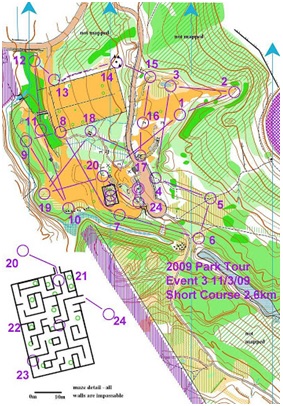
From 2016 a night event was added as an adjunct to the Urban series. (The club had previously held (mostly annual) night championship events on bush maps).
In 2018 the series was re-branded as the UFO Series (Urban Foot Orienteering). When the venue is suitable many events now include a short, non-competitive introductory "mini course" for juniors and newbies to orienteering.
Finally, the biggest logistical hurdle that the Urban series faces has been (and will continue to be) finding suitable areas and mapping them. Of course this problem is common to all forms of orienteering. To this end Newcastle Orienteering Club is grateful for the efforts of long time mappers including Denis Lyons, Russell Rigby and Ian Dempsey who have overseen the production of many of the maps we currently use.
This series of short coaching articles by former club coach Geoff Todkill originally appeared in the club's printed newsletter. They contain a wealth of information for those wanting to develop their orienteering skills, from beginners to the more experienced.
- Bush course difficulty levels: Blue, Green, Orange and Red have been replaced by Very Easy, Easy, Moderate and Hard.
-
Control punch cards have been replaced by SportIdent electronic punching.
-
Marking your map / drawing your course on the map - the majority of events now have pre-printed maps.
- A couple of map symbols have changed (eg. termite mounds) and some control descriptions have been updated.
| Issue 1 | Map terrain skills |
| Issue 2 | Blue and Green skills and orienting a map |
| Issue 3 | Orange and Red skills and thumbing a map |
| Issue 4 | Contouring, Attack Points and Route Choice |
| Issue 5 | Aiming off and Leg Analysis |
| Issue 6 | Relocation and Catching Features |
| Issue 7 | |
| Issue 8 | |
| Issue 9 | Control Descriptions and Route Choice |
| Issue 10 | Control Descriptions |
| Issue 11 | |
| Issue 12 | Traffic Light Orienteering |
| Issue 13 | Route Choice and Techniques revisited |
| Issue 14 | |
| Issue 15 | Techniques revisited |
| Issue 16 | Picturing the control site |
| Issue 17 | Route Choice |
| Issue 18 | Hints on Approaching Controls |
| Issue 19 | Race Procedure |
| Issue 20 | Errors |
| Issue 21 | Route Choice |
| Issue 22 | |
| Issue 23 | Rough and Fine Orienteering |
| Issue 24 | Consistency |
| Issue 25 | |
| Issue 26 | |
| Issue 27 | Skills for Orange and Red and Basics Revisited |
| Issue 28 | Route Choice |
| Issue 29 | Control Descriptions Part 1 |
| Issue 30 | Control Descriptions Part 2 |
| Issue 31 | Reading Control Descriptions |
| Issue 32 | Preparation and Skills for Red |
| Issue 33 | Orienteering Basics |
| Issue 34 | Route Choice |
| Issue 35 | |
| Issue 36 | Preparation |
| Issue 37 | |
| Issue 38 | |
| Issue 39 | Basics Part 1 |
| Issue 40 | Basics Part 2 |
| Issue 41 | |
| Issue 42 | Compass technique and contours |
| Issue 43 | Intermediate techniques Part 1 |
| Issue 44 | |
| Issue 45 | Intermediate techniques Part 2 |